Cavruqen
Flow Module
Flow Module
Couldn't load pickup availability
1. Problem Statement
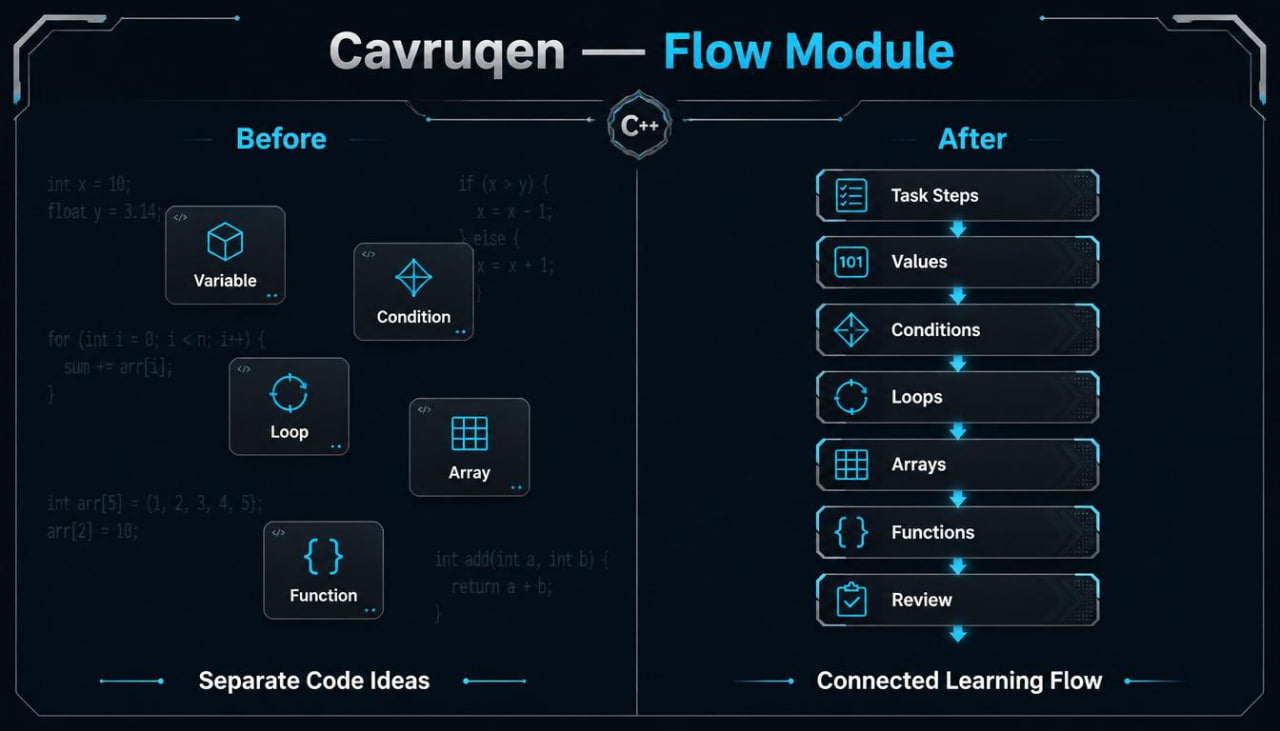
When a learner completes several basic C++ topics, a new challenge may appear: the amount of material grows, while the connection between sections is not always clear right away. A separate topic may be understandable while reading, but in a wider example it begins to overlap with other parts of code. A learner may understand a variable, condition, loop, or function separately, yet feel unsure when all these elements work together inside one task. Another challenge appears when the learner needs not only to find an issue, but also explain why the logic of an example moves in a certain direction. Flow Module is created to connect topics into a learning flow and show how C++ parts can move into one another inside structured materials.
2. Solution
Flow Module presents study through a sequence of modules where each next section builds on the previous one. The materials do not treat topics in isolation; they show how topics interact in short and medium examples. The learner sees how a value is created, checked, changed, repeated in a loop, passed into a function, or stored in a data group. This approach helps read code not as unrelated lines, but as one learning route. Flow Module fits learners who want to move from separate concepts into work with connected C++ blocks.
3. What’s Inside
Flow Module includes a group of learning modules that connect familiar C++ topics into a more complete sequence. If Flux Guide focused on data movement inside examples, Flow Module expands this idea to the level of learning blocks. Here, it is important not only to trace one value, but to see how a whole code fragment is formed from several stages: preparing values, checking conditions, repeating actions, moving logic into functions, and reviewing the final result.
The first block of Flow Module is dedicated to reviewing the learning base. The learner returns to variables, value types, simple expressions, conditions, loops, and functions, but now through a modular presentation. Each topic is viewed not on its own, but as a part of a future example. For instance, a variable can be a preparation element, a condition can be a choice point, a loop can be a repetition element, and a function can be a separate part of the logic. This block helps the learner see that topics do not exist as separate islands, but can form a connected learning route.
The second block focuses on creating a short algorithmic description before code. The learner practices reading a task and describing it not immediately in C++, but as a plain sequence of actions. For example: receive a value, check a condition, repeat an action several times, keep an intermediate result, show the final result. This approach helps the learner avoid starting with random lines and first create a readable scheme. The materials can include exercises where the learner divides a task into steps, places actions in the right order, or explains why one step should come before another.
The third block works with variables and intermediate values. Here, the learner sees how, inside one module, a value can move through several stages: first creation, change, check, reuse, and output. Examples can include counting, updating a value in a loop, keeping a temporary result, or comparing two values after several actions. After each example, there is a step-by-step breakdown showing what happens to the data at each stage.
The fourth block is dedicated to conditional movement. In Flow Module, conditions are presented as places where the learning flow can move in different directions. The learner reviews examples with several check options, nested blocks, combined conditions, and results that depend on previous values. Tasks can ask the learner to define which path the code will take, change a condition so the result becomes different, or explain why a certain block does not run. This block develops attention to choice logic.
The fifth block focuses on loops as part of the learning flow. The learner views repetition not as a separate topic, but as an element that can affect the whole example. A loop can change a value, move through a data group, collect a result, or prepare information for the next block. The materials can include loop pass tables, short repetition schemes, and exercises for defining the number of repetitions. Separate notes explain common inaccuracies: a wrong loop border, counter change in an unsuitable place, extra repetition, or a missed value update.
The sixth block brings arrays and strings into a modular structure. The learner works with value groups and text fragments as material that can be checked, changed, reviewed through a loop, or passed into a function. Examples can show finding an element, counting values, checking a text fragment, changing one character, or creating a short final message. These topics are not presented as isolated theory; they appear where they are needed for the general logic of the module.
The seventh block is dedicated to functions as a way to divide a learning example into parts. Here, the learner sees how a function can receive a value, perform a separate action, and return a result to the main part of the example. The materials explain how to read the connection between the call location and the function description, how not to mix parameters with already created variables, and how to check what comes back after execution. Tasks can ask the learner to complete a function, explain its role, change a parameter, or trace the result after the call.
The eighth block of Flow Module contains modular exercises. These are tasks where the learner works not with one line, but with a small structure. For example, the learner needs to read a description, define needed variables, choose a condition, add a loop, move part of the logic into a function, and check the created fragment. These exercises should not be large, but they teach the learner to see the order of code building and the role of each element.
The ninth block is dedicated to reviewing prepared learning fragments. The learner receives short examples and needs to explain the structure: where the data is prepared, where the condition is placed, where repetition appears, where the function is used, and where the final output is located. Some examples can include intentional inaccuracies so the learner practices attention to order and logic. Explanations after each exercise show how to read code as a connected system, not as a group of separated lines.
Flow Module can also include working tables for analysis. One table can focus on variables and their values, another on loop passes, a third on conditional movement, and a fourth on functions and passed values. These materials help the learner return to broader examples and review them calmly.
The final part of Flow Module is a closing modular block. Several learning tasks combine the tier topics: variables, conditions, loops, arrays, strings, and functions. Each task has a description, an action scheme, space for independent work, checking hints, and a short breakdown. Through this, the learner sees how C++ topics can work inside one learning flow.
4. Who is this for?
Flow Module is for learners who already know basic and middle-stage C++ topics and want to better see the connection between them. This tier is for those who need more than separate examples and want to work with learning modules where one topic naturally moves into another. It can fit after Flux Guide, when the learner already understands value movement, but wants to apply that understanding in broader fragments.
This tier also fits learners who want to read code as a connected structure. In Flow Module, it is important not only to recognize a variable, loop, or function, but to explain why they are placed in that order and what role they have in the general logic. The materials are useful for those who like schemes, tables, step-by-step exercises, and review of prepared examples.
Flow Module is created for independent study without pressure. It helps the learner move from separate concepts into connected learning blocks and better understand how a short C++ solution is formed.
5. What You’ll Learn
- How to see C++ code as a sequence of connected actions.
- How to describe a task in plain steps before writing code.
- How to trace variables through several stages of an example.
- How to understand conditional movement in a learning fragment.
- How to analyze a loop as part of broader logic.
- How to work with arrays inside short tasks.
- How to use strings in learning examples.
- How to read functions through parameters, action, and result.
- How to see the connection between a function call and its description.
- How to complete modular exercises with several parts.
- How to explain the order of code execution.
- How to use tables for value analysis.
- How to find inaccuracies in the sequence of actions.
- How to combine variables, conditions, loops, arrays, strings, and functions.
- How to review learning tasks from description to checking.
6. Store Terms
Flow Module is a paid Cavruqen learning tier. The page can mention a 30-day request window related to payment matters according to the store policy.
Self-paced learning overview
- 📁 Digital file available after purchase
- 🧭 Long-term availability
- 🔒 Secure checkout
- 📅 Content updated in 2026
What format are the materials provided in?
What format are the materials provided in?
The materials are provided as structured learning files, modules, examples, short explanations, and practical tasks. Each tier has its own amount of content, but the general structure stays the same: topic introduction, example, task, and review.
Do I need previous C++ knowledge before starting?
Do I need previous C++ knowledge before starting?
For the starting tiers, previous preparation is not required. They are created for learning basic ideas, syntax, code structure, and simple examples. Higher tiers may include more topics, exercises, and explanations for learners who already know the basics.
Can I request a refund after purchasing a paid tier?
Can I request a refund after purchasing a paid tier?
Paid tiers may include a 30-day refund request period according to the store policy. Since the first tier is free, no payment is required for it, so this point can be presented as information for future paid materials.
Share