Cavruqen
Halo Collection
Halo Collection
Couldn't load pickup availability
1. Problem Statement
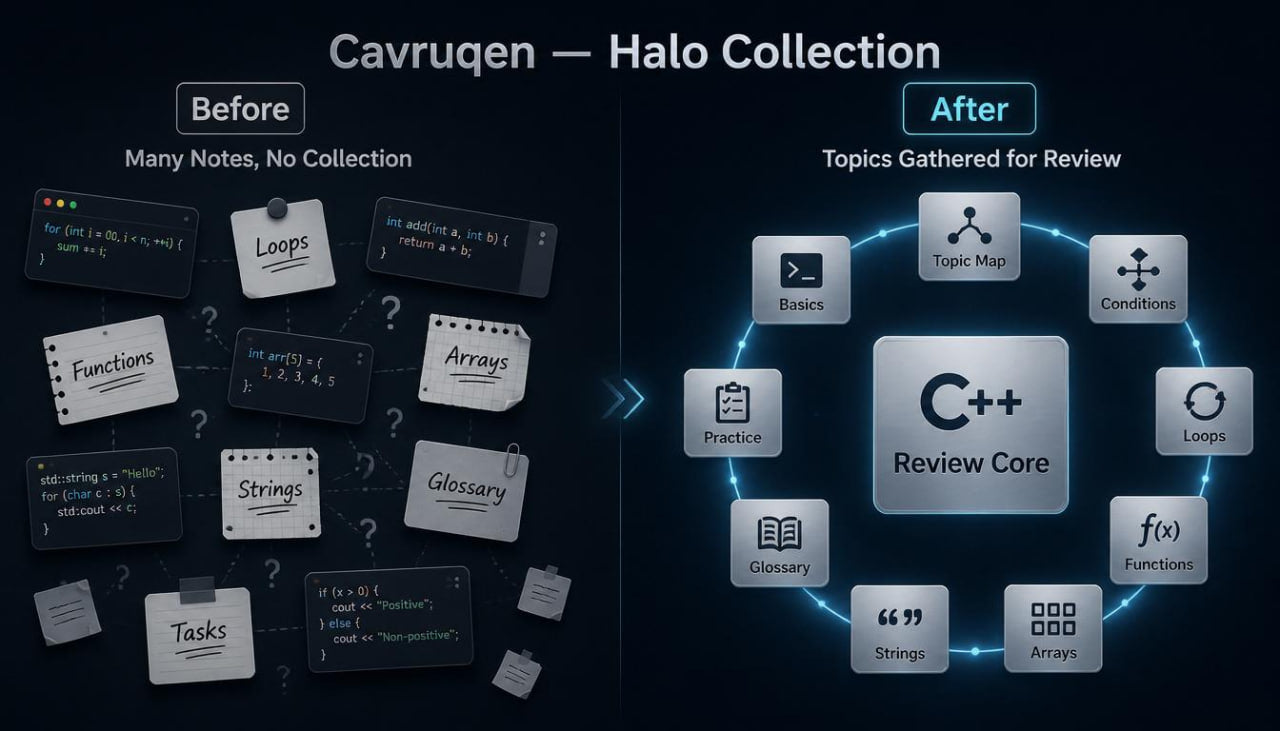
At the stage where a learner has already worked with variables, conditions, loops, functions, arrays, and strings, there is often a need for a wider set of materials. Separate modules may be understandable, but without an organized system it can be hard to return to topics, review terms, and compare different constructions with one another. A learner may have many examples, but not always see which ones belong to basic review, which ones belong to logic analysis, and which ones belong to practical tasks. Confusion can also appear between reading materials, editing exercises, and tasks for writing independent fragments. Halo Collection is created as a wider learning set where materials are organized around topics, review, and practice.
2. Solution
Halo Collection presents C++ as an organized collection of learning sections where each block has a clear place. The materials combine explanations, examples, practical exercises, tables, schemes, a glossary, and review sections. This format helps the learner avoid getting lost among topics and return to the needed block in a convenient order. The tier gives more attention to comparing constructions, analyzing prepared examples, and gradually creating short solutions. Halo Collection fits learners who want a wider learning set for C++ without loud claims.
3. What’s Inside
Halo Collection contains an expanded set of C++ materials built around review, analysis, and practical work. If Flow Module helped view topics as a learning flow, Halo Collection gathers these topics into a wider structure that can be revisited during independent study. The name Halo reflects the idea of a learning circle: the learner studies a topic, sees an example, completes a task, reviews a term, and returns to the material with a new layer of understanding.
The first block of Halo Collection is a topic map. It gathers the key sections of the tier: C++ program structure, variables, value types, expressions, conditions, loops, functions, arrays, strings, simple algorithmic steps, and issue analysis. This map does not replace learning modules; it helps the learner understand where each topic is placed. The learner sees the general picture and can move from short review to deeper analysis.
The second block is dedicated to reviewing the basics. It gathers short explanations about how C++ code is read, how variables are created, how values are used, how commands work, and how simple expressions are built. The materials do not present these topics again from zero; they help refresh them before more detailed examples. Each topic can include a small example, a short breakdown, and 2–3 self-check tasks.
The third block focuses on conditions and choice logic. Here, the learner works with if, else, several checks, logical links, and different execution options. The materials show how values affect the code path, how to read blocks inside conditions, and how to notice unclear logic. Exercises can ask the learner to define which block will run, change a condition, explain the result, or find an inaccuracy in an example.
The fourth block is dedicated to loops. It contains examples with counters, moving through a group of values, collecting a result, and repeating actions. Each example can include a step table showing variable values during each pass. This format helps the learner see not only loop syntax, but also how data changes during repetition.
The fifth block works with functions. It explains how a function helps separate a single action, how it receives values, how it runs internal logic, and how it returns a result. The materials can include examples of functions for calculation, checking, processing one element, or creating a short message. Tasks can ask the learner to complete a function, explain its role, change parameters, or trace what happens after a call.
The sixth block is dedicated to arrays and data groups. The learner sees how to keep several values, how to refer to a single element, how to move through a group with a loop, and how to perform simple actions with elements. The materials can include exercises for finding a value, counting elements by condition, changing one element, and explaining the order of movement through a group. A separate table with indexes can help the learner see the link between position and value.
The seventh block reviews strings. Here, the learner works with text values, characters, string length, simple comparison, and joining text fragments. Examples can show changing a message, checking a character, reading a text variable, or forming a short result. Strings add another type of thinking because the learner works not only with numbers, but also with text parts.
The eighth block of Halo Collection is a set of code reading tasks. The learner receives short fragments where they need to explain what happens, which line runs, how a value changes, and what result is formed. Some tasks may require no writing at all: only reading, analysis, and explanation. This is useful for attentive code work because it trains attention to order and detail.
The ninth block is editing learning examples. Here, the learner sees fragments with intentional inaccuracies: a missing symbol, a different variable name, an unsuitable condition, an extra line, a wrong loop border, or confusion in function parameters. After each task, there is an explanation of how to find the issue and how the edited fragment changes the behavior of the example.
The tenth block is a learning glossary. It can include terms such as variable, value, type, expression, statement, condition, loop, counter, function, parameter, return, array, index, string, character, output, input, and block. Each term includes a short explanation and a small example. The glossary helps the learner review concepts without searching through all modules.
Halo Collection can also include comparison tables. For example: variable and array, condition and loop, parameter and variable, character and string, function description and function call. These tables help the learner see differences between concepts that are often mixed during practice.
The final part of Halo Collection is a closing set of exercises. It can include several tasks where the learner combines variables, conditions, loops, functions, arrays, and strings. Each task has a description, hints for analysis, space for independent work, and a breakdown. As a result, the tier works as a wide learning collection that can be revisited during further C++ study.
4. Who is this for?
Halo Collection is for learners who have already completed several stages of C++ and want a wider set of materials for review and practice. This tier is for those who need not only separate modules, but a system with explanations, tables, examples, exercises, and a glossary.
It also fits learners who want to better distinguish similar ideas: condition and loop, parameter and variable, array and single value, character and string. In Halo Collection, these topics are presented with examples, so the learner can not only read a definition, but also see the difference in code.
This tier can be convenient for independent study, review after a pause, or preparation for broader topics in the next Cavruqen tiers. It does not use large promises; it gives an organized system of materials for attentive work.
5. What You’ll Learn
- How to navigate a wider set of C++ materials.
- How to review basic topics through short examples.
- How to read conditions with several options.
- How to analyze loops through a step table.
- How to trace value changes during repetition.
- How to read functions through parameters and result.
- How to work with arrays and indexes.
- How to explain movement through a group of values.
- How to work with strings and characters.
- How to read short fragments without writing new code.
- How to find inaccuracies in learning examples.
- How to use a glossary for reviewing terms.
- How to compare similar ideas through tables.
- How to combine several topics in one task.
- How to form your own explanation of code logic.
6. Store Terms
Halo Collection is a paid Cavruqen learning tier. The page can mention a 30-day request window related to payment matters according to the store policy.
Self-paced learning overview
- 📁 Digital file available after purchase
- 🧭 Long-term availability
- 🔒 Secure checkout
- 📅 Content updated in 2026
What format are the materials provided in?
What format are the materials provided in?
The materials are provided as structured learning files, modules, examples, short explanations, and practical tasks. Each tier has its own amount of content, but the general structure stays the same: topic introduction, example, task, and review.
Do I need previous C++ knowledge before starting?
Do I need previous C++ knowledge before starting?
For the starting tiers, previous preparation is not required. They are created for learning basic ideas, syntax, code structure, and simple examples. Higher tiers may include more topics, exercises, and explanations for learners who already know the basics.
Can I request a refund after purchasing a paid tier?
Can I request a refund after purchasing a paid tier?
Paid tiers may include a 30-day refund request period according to the store policy. Since the first tier is free, no payment is required for it, so this point can be presented as information for future paid materials.
Share