Cavruqen
Luma Map
Luma Map
Couldn't load pickup availability
1. Problem Statement
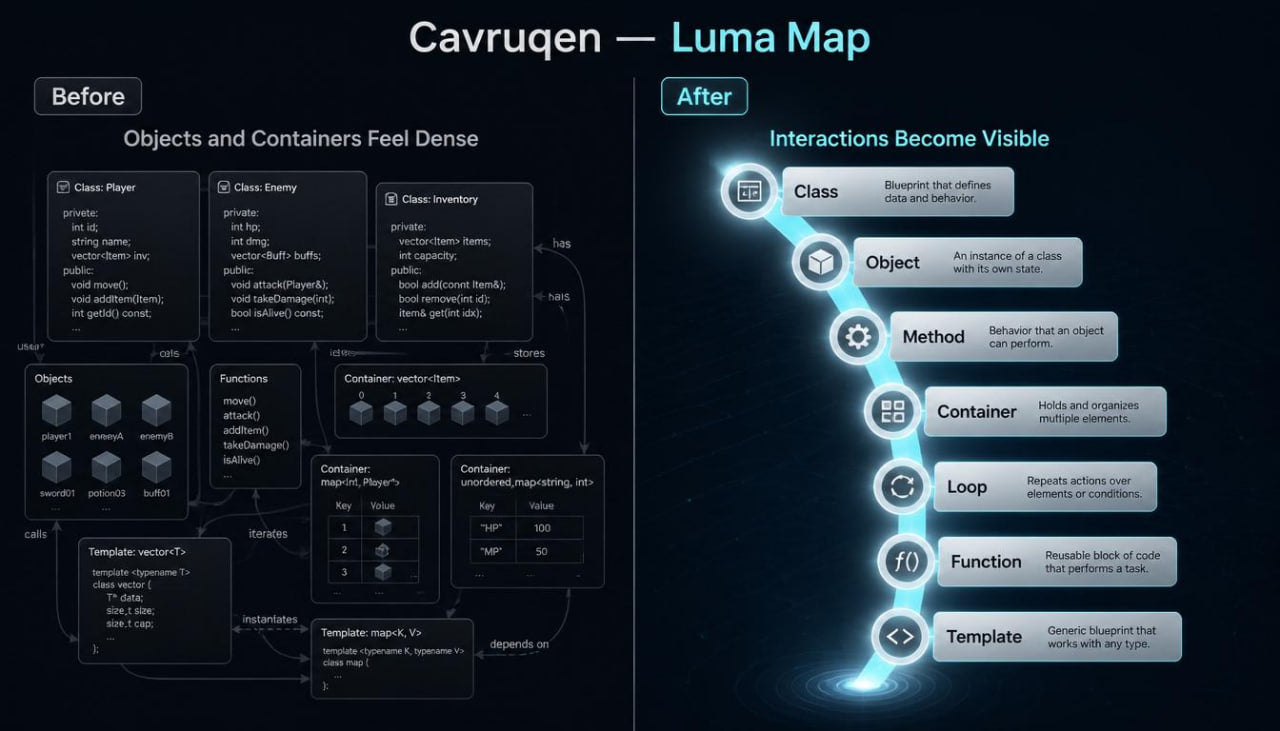
When a learner moves from separate topics to wider C++ examples, code begins to have more layers. Classes, objects, methods, containers, templates, nested structures, and fragments appear where one part of code affects another through data or a function call. Because of this, it becomes harder not only to write fragments, but also to read prepared code without losing the logic. A learner may understand what a class or function is, but feel unsure when objects are stored in a container, passed between functions, or used together with template-based parts. Luma Map is created to highlight these links and help the learner move through wider topics in a structured order.
2. Solution
Luma Map presents C++ as a lit-up map of more detailed learning links. Each module shows how classes, objects, functions, containers, and templates can work together in short and medium examples. The materials do not overload the learner with large projects, but divide wider topics into clear learning blocks: description, structure, example, breakdown, exercise, and summary. The tier gives strong attention to code reading, comparison of similar ideas, and explanation of the data route. Luma Map fits learners who have already completed basic, middle-stage, and node-based C++ topics and want to work with more organized logic.
3. What’s Inside
Luma Map contains a learning map for wider C++ topics where the learner moves from understanding separate constructions to analyzing interaction between code parts. If Vertex Map showed C++ nodes and the links between them, Luma Map adds light to the places where these links become more detailed: objects keep data, methods perform actions, containers group values, templates make it possible to describe similar structures in a generalized way, and functions help pass logic between parts of an example.
The first block of Luma Map is a review of the topic map with a new focus. The learner returns to variables, functions, arrays, strings, structures, classes, objects, references, and pointers, but not as separate sections. The materials show how these elements can appear together in wider examples. For example, a class can contain data, a method can change that data, a function can receive an object, and a container can store several such objects. This opening helps the learner prepare for reading interactions, not only separate lines.
The second block is dedicated to classes and objects in a wider structure. Here, the learner reviews that a class describes a group of data and actions, while an object is a separate example of that description. Then the materials show how to create several objects, how to change their fields through methods, how to read values, how to compare objects, and how not to mix the class description with a concrete object. The examples remain educational and short, but now include more internal connections.
The third block reviews methods as actions connected to an object. The learner sees how a method uses object data, changes internal state, returns a result, and differs from a regular function. The materials can include examples with methods for updating a value, checking state, forming a short text result, or calculating from fields. After each example, there is a breakdown: which data belongs to the object, what the method changes, and what result is formed.
The fourth block is dedicated to constructors. A constructor is presented as a class part that helps set the starting state of an object when it is created. The learner sees how starting values are passed, how they move into fields, why the starting state matters for later actions, and how to read an example with several objects. Tasks can ask the learner to complete a constructor, change starting data, explain which values an object will have after creation, or find an inaccuracy in the initialization order.
The fifth block introduces containers as a way to keep groups of values or objects. The materials explain that a container can hold a group of elements that can be reviewed, changed one by one, searched, or used to form a final result. The learner works with examples where numbers, text values, or objects of a simple class are stored. Attention is given to how a loop interacts with a container and how an element is used inside repetition.
The sixth block is dedicated to moving through containers. The learner studies how to read a loop that reviews elements, how to understand the current element, how to update values, and how to work carefully with conditions inside repetition. Examples can include counting elements, finding a value, filtering by condition, changing part of the data, or forming a short report. After each example, a step table shows what happens at each pass.
The seventh block introduces templates in a learning format. A template is presented as a way to describe similar logic for different value types. The materials begin with simple function-template examples: comparing two values, returning one of them, or processing a simple parameter. Then the learner sees how a template helps avoid repeating the same structure for different types. Explanations stay careful: first the idea of generalization, then short syntax, then an example, and only after that an exercise.
The eighth block works with passing objects into functions. The learner sees the difference between passing a copy, passing by reference, and passing for reading without change. The materials explain this through short examples where a function receives an object, reads its data, changes a value, or forms a result. In this block, it is important to show that the way of passing data affects the behavior of the example. Tasks can ask the learner to define whether the object changes after a function call and explain why.
The ninth block of Luma Map contains comparison exercises. The learner works with tables: class and structure, object and variable, method and function, constructor and regular method, container and array, template and regular function. Each table includes a short explanation, an example, and self-check questions. This format helps avoid mixing ideas that can look similar at first.
The tenth block is dedicated to reading wider examples. The learner receives fragments where classes, objects, methods, containers, loops, and functions work together. Tasks can ask the learner to find where an object is created, where a method is called, where a container is reviewed by a loop, where a value changes, and where a final result is formed. This analysis helps the learner see code structure as a map of interactions.
Luma Map can also include a block with learning inaccuracies. It reviews issues that may appear in wider examples: mixing a class with an object, an incorrect method call, a wrong object creation order, changing a copy instead of the original value, moving through a container incorrectly, or using a template unclearly. Each exercise includes an explanation of what needs editing and how it affects the logic.
The final part of Luma Map is a closing learning map. Several tasks combine classes, objects, methods, constructors, containers, loops, functions, references, and templates. Each task has a description, a connection map, analysis hints, space for independent work, and a detailed breakdown. This makes the tier useful for learners who want not only to review topics, but also to see how they interact inside a C++ example.
4. Who is this for?
Luma Map is for learners who already know C++ basics, functions, arrays, strings, structures, classes, objects, references, and pointers. This tier is for those who want to move into wider learning examples where several topics work together inside one logic.
It also fits learners who want to better understand object-based C++ structure without jumping randomly between concepts. In Luma Map, classes, methods, objects, constructors, containers, and templates are presented as parts of one map, not as disconnected topics.
This tier can be convenient for independent study, review after previous Cavruqen tiers, and preparation for broader tasks in Nexus Map. It focuses on structure, analysis, and practical work with learning examples.
5. What You’ll Learn
- How to see wider C++ topics as a map of interactions.
- How to read classes and objects in learning examples.
- How to tell the difference between a class description and a concrete object.
- How methods work with object data.
- How a constructor sets the starting state.
- How to create several objects and read their values.
- How to work with containers for groups of values.
- How to move through a container with a loop.
- How to analyze element changes during repetition.
- How to read simple function templates.
- How to compare a template and a regular function.
- How to pass objects into functions in different ways.
- How to see the difference between a copy and a reference.
- How to find inaccuracies in examples with classes and containers.
- How to explain the interaction of several C++ topics in your own words.
6. Store Terms
Luma Map is a paid Cavruqen learning tier. The page can mention a 30-day request window related to payment matters according to the store policy.
Self-paced learning overview
- 📁 Digital file available after purchase
- 🧭 Long-term availability
- 🔒 Secure checkout
- 📅 Content updated in 2026
What format are the materials provided in?
What format are the materials provided in?
The materials are provided as structured learning files, modules, examples, short explanations, and practical tasks. Each tier has its own amount of content, but the general structure stays the same: topic introduction, example, task, and review.
Do I need previous C++ knowledge before starting?
Do I need previous C++ knowledge before starting?
For the starting tiers, previous preparation is not required. They are created for learning basic ideas, syntax, code structure, and simple examples. Higher tiers may include more topics, exercises, and explanations for learners who already know the basics.
Can I request a refund after purchasing a paid tier?
Can I request a refund after purchasing a paid tier?
Paid tiers may include a 30-day refund request period according to the store policy. Since the first tier is free, no payment is required for it, so this point can be presented as information for future paid materials.
Share