Cavruqen
Nexus Map
Nexus Map
Couldn't load pickup availability
1. Problem Statement
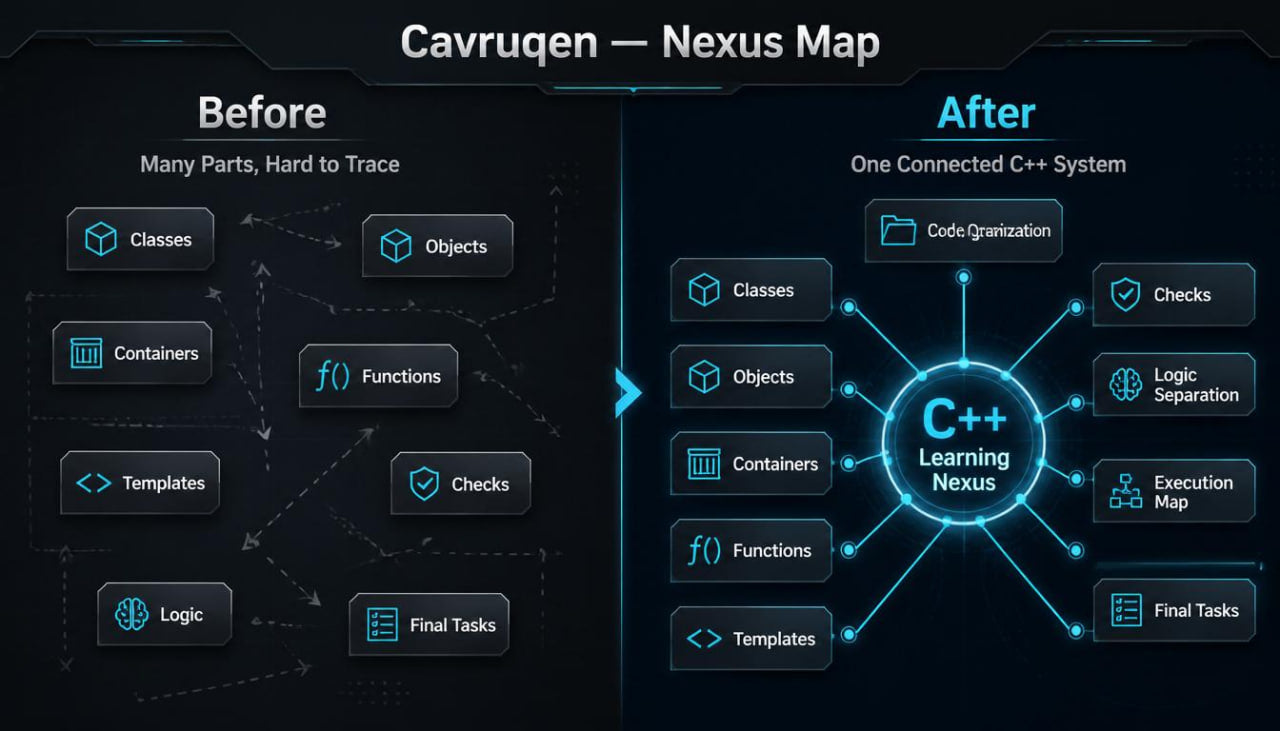
At a more advanced stage of C++ study, the learner already sees many topics, but the main challenge is often gathering them into a clear system. Classes can contain data and methods, objects can be passed into functions, containers can keep groups of values, and templates can describe similar logic for different types. If these parts are not connected, the study process can look like a set of separate sections without a shared structure. Another challenge appears when reading longer examples where several levels of action need to be traced at the same time. Nexus Map is created to connect key topics into one learning map and show how they interact in wider C++ fragments.
2. Solution
Nexus Map presents C++ as a system of links between data, actions, functions, objects, and modules. The materials are arranged so the learner can move from separate ideas to more complete code reading. Each section includes explanations, examples, schemes, analysis tasks, editing exercises, and closing tasks. Strong attention is given to organizing logic: where to keep data, where to perform an action, how to pass values, and how to divide code into parts. Nexus Map fits learners who have already completed previous Cavruqen tiers and want to work with a wider set of learning examples.
3. What’s Inside
Nexus Map contains the widest learning map in the Cavruqen line. If Luma Map highlighted the interaction of classes, objects, containers, and templates, Nexus Map gathers these topics into one system. The name Nexus reflects the idea of a connection point: each topic has its own place, but its learning value becomes clearer when the learner sees how it works with other parts.
The first block of Nexus Map is a general map of C++ structure. It shows how variables, functions, conditions, loops, arrays, strings, structures, classes, objects, containers, references, pointers, templates, and error handling are connected. This map helps the learner see not a chaotic group of topics, but a learning system with separate nodes. Each node has a short explanation, an example of its role in code, and a link to other nodes.
The second block is dedicated to code organization. The learner reviews how to divide an example into parts: data preparation, calculation, checking, repetition, handling groups, working with objects, and final output. The materials show that a longer code fragment is better read not as one solid text, but as a sequence of responsible zones. In the tasks, the learner defines where the preparation part is placed, where handling takes place, where checking appears, and where the result is formed.
The third block works with classes as a base for organized description. The learner reviews fields, methods, constructors, and objects, but now in the context of a wider structure. Examples can show a class that keeps data, a method that updates state, a function that reads an object, and a container that keeps several objects. After each example, there is a connection map: what belongs to the class, what belongs to the object, what the method performs, and where an outside function interacts with this data.
The fourth block is dedicated to objects in containers. The learner sees how several objects can be kept together and handled through a loop. The materials explain how to create a group of objects, how to move through each element, how to read a field, how to call a method, and how to form a final value. Tasks can ask the learner to find an object by condition, change a value inside one element, count objects by a certain feature, or explain what happens at each loop pass.
The fifth block reviews the interaction of functions and objects. The learner studies how a function can receive an object, read its data, change state through a reference, or return a new result. The materials compare different ways of passing data: copy, reference, and reading without change. Explanations use short examples so the learner sees not only syntax, but also the difference in behavior. Exercises can ask the learner to define whether the object changed after the call, which values were passed, and where the result was formed.
The sixth block is dedicated to templates in a wider context. The learner sees a template not as a separate topic, but as a way to describe repeated logic for different value types. The materials can include function templates for comparison, selection, element handling, or working with a container. The explanation begins with the idea of generalization, then moves to syntax, a short example, a type table, and a practical exercise. This helps the learner see where a template fits inside a learning fragment and where a regular function may be clearer.
The seventh block introduces basic error handling in a learning format. This is not about complex systems; the materials show how code can account for an incorrect value, an empty group, a wrong index, or a case where an action does not have expected data. The learner sees how checks help make an example clearer to read. Tasks can ask the learner to add a check before an action, explain why a certain case should be reviewed separately, or find a place where data is used without an earlier check.
The eighth block is dedicated to logic separation. The learner reviews which parts of an example should stay in the main flow and which can be moved into a function or method. The materials show how a function name helps read an action, how a method is connected with object data, and how a long fragment can be divided into clearer parts. In the exercises, the learner analyzes a prepared example and suggests which parts can be separated for better readability.
The ninth block of Nexus Map contains tasks for reading wide fragments. The learner receives examples where objects, containers, functions, methods, conditions, loops, and templates work together. Tasks can ask the learner to create an execution map: where data is created, where it changes, where it is checked, where it passes through a loop, and where the result appears. This format helps read C++ as a system of interactions, not as a group of lines.
The tenth block is dedicated to structure editing. The learner sees examples where logic is unclear: a function performs too many actions, a method changes data without a clear reason, a container is reviewed in an unsuitable way, a check is placed too late, or names do not show the role of elements. The task is to suggest a neater structure. After each exercise, there is an explanation of how the structural change makes the example clearer.
The eleventh block contains learning comparison maps. They compare class and structure, method and function, container and array, copy and reference, template and regular function, data check and handling an incorrect case. Each map has a short description, example, difference table, and review questions.
The final part of Nexus Map is a closing series of learning tasks. It combines topics from the whole line: basic structure, variables, conditions, loops, functions, arrays, strings, pointers, references, structures, classes, objects, containers, templates, and error handling. Each task has a description, topic map, step-by-step hints, space for independent work, and a detailed breakdown. The closing block helps show how different C++ topics can work in one learning space.
4. Who is this for?
Nexus Map is for learners who have already completed basic, middle-stage, and wider C++ topics and want to work with more complex learning examples. This tier is for those who want to see the link between classes, objects, functions, containers, templates, and error handling.
It also fits learners who want to read longer code fragments with closer attention. In Nexus Map, the learner does not only recognize separate constructions, but practices explaining how they interact: where data is created, how it is passed, where it changes, how it is checked, and where it forms a result.
This tier can be convenient for independent study after previous Cavruqen materials. It is created for learners who need a wide map of C++ topics, many examples, analysis exercises, comparison tables, and closing tasks.
5. What You’ll Learn
- How to see C++ as a system of connected topics.
- How to read wider code structure by parts.
- How to organize data, actions, and checks.
- How to work with classes in wider examples.
- How to read objects, methods, and constructors.
- How to keep objects in containers.
- How to move through a group of objects with a loop.
- How to pass objects into functions in different ways.
- How to compare copy, reference, and reading without change.
- How to read templates in learning fragments.
- How to add basic checks before an action.
- How to separate logic between functions and methods.
- How to analyze longer fragments through an execution map.
- How to find inaccuracies in code organization.
- How to combine topics from the full Cavruqen line in one learning task.
6. Store Terms
Nexus Map is a paid Cavruqen learning tier. The page can mention a 30-day request window related to payment matters according to the store policy.
Self-paced learning overview
- 📁 Digital file available after purchase
- 🧭 Long-term availability
- 🔒 Secure checkout
- 📅 Content updated in 2026
What format are the materials provided in?
What format are the materials provided in?
The materials are provided as structured learning files, modules, examples, short explanations, and practical tasks. Each tier has its own amount of content, but the general structure stays the same: topic introduction, example, task, and review.
Do I need previous C++ knowledge before starting?
Do I need previous C++ knowledge before starting?
For the starting tiers, previous preparation is not required. They are created for learning basic ideas, syntax, code structure, and simple examples. Higher tiers may include more topics, exercises, and explanations for learners who already know the basics.
Can I request a refund after purchasing a paid tier?
Can I request a refund after purchasing a paid tier?
Paid tiers may include a 30-day refund request period according to the store policy. Since the first tier is free, no payment is required for it, so this point can be presented as information for future paid materials.
Share