Cavruqen
Vertex Map
Vertex Map
Couldn't load pickup availability
1. Problem Statement
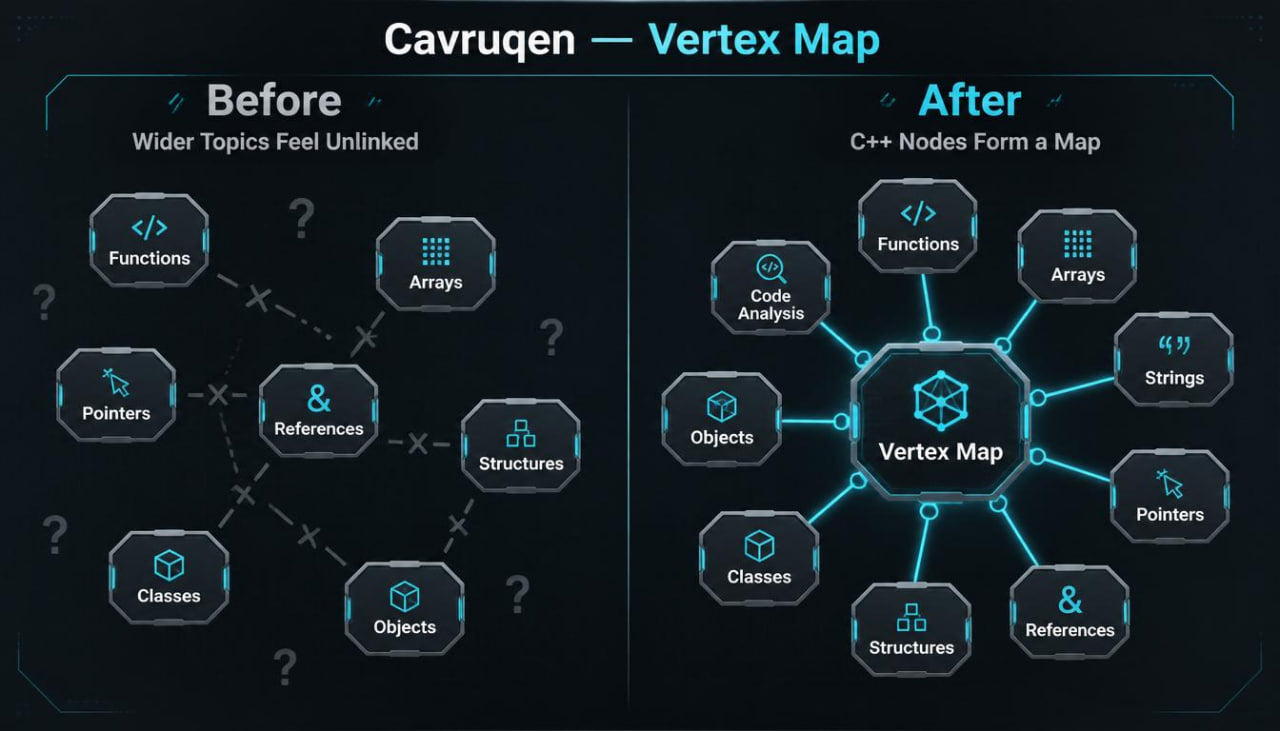
When a learner moves into broader C++ topics, it can become harder to understand the links between different parts of the language. Functions can work with arrays, structures can keep several values, classes can describe objects, and pointers and references can change the way data is handled. If these topics are studied separately, they can feel disconnected and harder to review. A learner may understand a small example, but feel lost when several constructions appear in one fragment. Vertex Map is created to show the key nodes of C++ and explain how they connect in learning tasks.
2. Solution
Vertex Map presents C++ as a topic map where each section has its place and its link to other parts. The materials help the learner see not only a single construction, but also its role in broader code logic. The tier contains explanations, examples, schemes, tables, practical tasks, and exercises for reading fragments. Special attention is given to topics that often need slower review: pointers, references, structures, classes, objects, and passing data between parts of code. Vertex Map fits learners who have already completed basic and middle-stage topics and want to move into deeper material organization.
3. What’s Inside
Vertex Map contains a learning map of C++ topics that helps the learner see connections between familiar ideas and new sections. If Halo Collection was a wide set for review and practice, Vertex Map takes the next step: it places topics as nodes on a map. Each node has an explanation, an example, a link to previous topics, and a task for independent work.
The first block of Vertex Map is a map of main C++ nodes. It shows how variables, value types, conditions, loops, functions, arrays, strings, pointers, references, structures, and classes are connected. This map helps the learner avoid seeing the material as a random order of sections. For example, variables connect to functions through parameters, arrays connect to loops through element movement, structures connect to grouped data, and classes expand the idea of describing objects.
The second block is dedicated to functions as connection points. The learner reviews how functions receive data, perform an action, and return a result. Then the materials show how functions can work with arrays, strings, structures, and objects. Examples can include a function for counting a value, checking a condition, processing a data group, or forming a short result. After each example, there is a breakdown: which data was passed, what changed inside the function, and what returned to the main part of the example.
The third block introduces pointers in a careful learning format. A pointer is explained as a variable that stores the address of another value. The materials do not overload the learner with heavy theory, but begin with short examples: creating a variable, receiving its address, creating a pointer, and reading a value through a pointer. A separate explanation shows the difference between the value itself, the address, and the variable that stores this address. Schemes are useful for this block: “value → address → pointer → reading the value.”
The fourth block is dedicated to references. The learner studies how a reference can work as another name for an existing value. The materials compare a regular variable, pointer, and reference through short examples. Tasks can ask the learner to explain what changes after editing a value through a reference, how to pass a value into a function, and why the result differs from passing a copy. In this block, it is useful to show the connection between functions and data-passing methods.
The fifth block works with structures. A structure is presented as a way to gather several connected values into one description. For example, a learning sample can contain a structure with a numeric value, a text label, and an additional parameter. The learner sees how a structure is created, how a variable of this type is declared, how its fields are read, and how a structure is passed into a function. Tasks can include adding a new field, reading values, changing one field, or explaining why grouped data can be clearer in this format.
The sixth block introduces classes and objects at a starting level. A class is explained as a description that can be used to create an object with its own data and actions. The materials can show a short class with fields, a method, and an example of creating an object. Explanations should be gradual: first the idea of a description, then internal data, then an action that belongs to this description, and only after that an example of use. Heavy terminology is avoided when it is not needed; the focus is on reading the structure.
The seventh block is dedicated to the link between structures, classes, and functions. The learner sees that data can not only be stored, but also passed into separate code parts for processing. The materials can include examples where a function receives a structure, a class object, or a single field. Tasks can ask the learner to define which data is passed, what changes after the function call, and where the final result is formed.
The eighth block of Vertex Map contains exercises for reading broader fragments. The learner receives examples where functions, arrays, structures, or classes work together. Tasks do not always require writing new code; sometimes the learner only needs to explain the data route, find where an object is created, define which function processes a value, or describe what happens after several actions. This type of exercise helps the learner read C++ with more attention.
The ninth block contains connection tables. One table can compare pointer and reference, another can compare structure and class, a third can compare array and structure, and a fourth can compare a function with a copied value and a function that receives a reference. Tables help the learner see differences between concepts that often seem similar during practice.
The tenth block is dedicated to issues in broader examples. It reviews inaccuracies linked to a wrong field reference, confusion between address and value, passing the wrong parameter, missing a returned result, or creating an object in the wrong order. After each exercise, there is an explanation of how to find the issue and why it affects the logic of the fragment.
The final part of Vertex Map is a closing task map. Here, the learner works with several learning examples where functions, arrays, strings, pointers, references, structures, and classes are combined. Each task has a description, topic map, analysis hints, space for independent work, and a logic breakdown. This makes the tier not just a large group of materials, but a learning map for deeper understanding of C++.
4. Who is this for?
Vertex Map is for learners who already know basic and middle-stage C++ topics and want to move into broader links between constructions. This tier is for those who have already worked with variables, conditions, loops, functions, arrays, and strings, but want to better understand pointers, references, structures, classes, and objects.
It also fits learners who want to read longer learning fragments without confusion. In Vertex Map, the materials help show where data is created, where it is passed, where it changes, where it is used, and how it returns into the general logic of the example.
This tier can be useful for independent study, review after previous Cavruqen levels, and preparation for broader learning tasks. It is not built on loud claims; its aim is to provide a structured topic map and tasks for attentive work with C++.
5. What You’ll Learn
- How to see C++ topics as a map of connected nodes.
- How functions connect different parts of an example.
- How data is passed into functions and returned back.
- What a pointer is inside a learning example.
- How to tell the difference between value, address, and pointer.
- How to read a reference as another name for a value.
- How to compare regular value passing and passing by reference.
- How to create and read structures.
- How to work with structure fields.
- How to read starting examples with classes and objects.
- How to see the link between a class, data, and actions.
- How to compare structures, classes, arrays, and functions.
- How to analyze broader code fragments.
- How to find inaccuracies in work with addresses, parameters, and fields.
- How to use a topic map for review.
6. Store Terms
Vertex Map is a paid Cavruqen learning tier. The page can mention a 30-day request window related to payment matters according to the store policy.
Self-paced learning overview
- 📁 Digital file available after purchase
- 🧭 Long-term availability
- 🔒 Secure checkout
- 📅 Content updated in 2026
What format are the materials provided in?
What format are the materials provided in?
The materials are provided as structured learning files, modules, examples, short explanations, and practical tasks. Each tier has its own amount of content, but the general structure stays the same: topic introduction, example, task, and review.
Do I need previous C++ knowledge before starting?
Do I need previous C++ knowledge before starting?
For the starting tiers, previous preparation is not required. They are created for learning basic ideas, syntax, code structure, and simple examples. Higher tiers may include more topics, exercises, and explanations for learners who already know the basics.
Can I request a refund after purchasing a paid tier?
Can I request a refund after purchasing a paid tier?
Paid tiers may include a 30-day refund request period according to the store policy. Since the first tier is free, no payment is required for it, so this point can be presented as information for future paid materials.
Share